Tuesday, January 5, 2010

Kraftwerk - We Are The Robots


Kraftwerk - Tanzmusik (1973)


Kraftwerk - Pocket Calculator Live 1981


Kraftwerk - Heimcomputer Live 1981


Kraftwerk's robotic, repetitive, all-electronic music influenced virtually every synthesizer band that followed in its wake. In the mid-'70s the German group literally invented the man-machine sound and image. In 1970 Ralf Hütter and Florian Schneider-Esleben, who had met studying classical music at the Dusseldorf Conservatory, founded Kling-Klang Studio. Their first recorded appearance together is on 1970's Tone Float, the debut by a psychedelic kraut-rock quintet called Organisation. After leaving that group, Hütter and Schneider took the name Kraftwerk ("power plant") and began experimenting with integrating mechanized sounds from everyday life into music. Following numerous lineup changes, during which two members defected to form the influential kraut-rock band Neu!, Kraftwerk was reduced to a duo. After Ralf and Florian (not released in the U.S. until 1975), the pair added Klaus Roeder and Wolfgang Flür.

They found immediate success with their first U.S. release, Autobahn, which went Top 5. The requisite hit was an edited version of the 22-minute minimalist title track about a monotonous journey along the famed German–Austrian superhighway. Kraftwerk’s next two LPs were paeans to such other modern-world wonders as the radio (Radio-Activity) and the train (Trans-Europe Express). David Bowie cited Ralf and Florian as an influence for his Low and “Heroes” albums. (There is some evidence that Bowie’s “V-2 Schneider” is a tribute.) Kraftwerk confirmed its cold, conceptualist image with “Trans-Europe Express” and “Showroom Dummies,” both of which became late-’70s disco hits. In 1977 the group toured the U.S. playing electronic instruments and dressed in mannequin outfits. The members later threatened to tour by sending over robots in lieu of themselves while they rested in their studio.

The Man-Machine featured more accessible music. Kraftwerk then disappeared for three years, not emerging until 1981 with the pop-oriented Computer World (#72, 1981), which stayed on the U.S. chart for 42 weeks and produced a #1 U.K. single, “The Model.” Meanwhile, the “Trans-Europe Express” melody and the rhythm of “Numbers” made their way into rap, on Afrika Bambaataa’s “Planet Rock.” After 1986’s Electric Café, Kraftwerk kept a relatively low profile, releasing only a best-of, The Mix.

Thanks to the flood of new techno, ambient, and experimental electronic sounds, in the ’90s a new set of fans embraced Kraftwerk’s catalogue and its ideas. The band headlined the U.K.’s Tribal Gathering concert in 1997 and has played select live dates, festivals, and raves. In 1999 the world exhibition organization Expo 2000 commissioned Kraftwerk to record “Expo 2000,” the event’s theme song. It doubled as a single.

from The Rolling Stone Encyclopedia of Rock & Roll (Simon & Schuster, 2001)

Have a groovy day :)

Peace and Love,
Retro Rebirth

If you liked this article, make sure you subscribe to the feed via RSS

Check out the Retro Rebirth Design Catalog

Cheap Trick Feature


Cheap Trick - Surrender (Rockpalast 1979)


Cheap Trick - I Want You To Want Me (Rockpalast 1979)


Cheap Trick is an American rock band from Rockford, Illinois, that gained popularity in the late 1970s. The band consists of Robin Zander (lead vocals, rhythm guitar), Rick Nielsen (lead guitar, backing vocals), Tom Petersson (bass guitar, backing vocals), and Bun E. Carlos (drums, percussion).

In 1961, Nielsen began playing locally in Rockford, utilizing an ever-increasing collection of rare and valuable guitars. He formed some local bands with names like The Phaetons, The Boyz, and The Grim Reapers. Finally, Nielsen formed Fuse in 1967 with Petersson, who had played in another local band called The Bo Weevils.

Fuse released a self-titled album for Epic Records in 1968, which was generally ignored. Frustrated by their lack of success, Fuse, which by then included Bun E. Carlos on drums, moved to Philadelphia in 1971. After spending a year in Europe, Nielsen and Petersson returned to Rockford and reunited with Carlos. Randy "Xeno" Hogan was briefly their lead singer, but then was replaced by Beloit, Wisconsin native Robin Zander, as the band was renamed as Cheap Trick.

Cheap Trick played local shows around Rockford, southern Wisconsin, and the Chicago area for a few years while they developed a unique stage show. They then opened shows for The Kinks, Boston, Santana, Kiss, and other headliners, as they toured constantly, playing as many as 250 shows a year. At the same time, the band developed a large fan base in Japan. Epic signed the group in 1976 and released its self-titled album in February 1977. The debut got great reviews but didn't sell. Their next two albums, In Color and Heaven Tonight, were well-received also. Heaven Tonight, with its teen anthem Surrender, is/was considered by many critics and fans as the group's best album.

Not one of Cheap Trick's first three albums made it into the Top 40 in the United States. In Japan, however, all three albums became gold records. When Cheap Trick went to Japan to tour the country for the first time, in 1978, they were received with a frenzy reminiscent of Beatlemania. During this tour, on April 28, 1978, Cheap Trick recorded a live show for their loyal Japanese fans at the Nippon Budokan. When that show was released as a live album titled At Budokan in 1979, their American obscurity changed for good. In Japan, they have remained popular superstars, even to the present day, and in fact, have been often referred to in the Japanese press as the "American Beatles".

At Budokan launched Cheap Trick into international stardom. Initially intended for release in Japan only, the album went triple platinum in the United States and reached #26 on the Swedish music charts. The smash track was the live version of "I Want You to Want Me", a song originally released on In Color. It reached #7, and "Ain't That A Shame" peaked at #35.

One song from At Budokan, "Need Your Love", had already been recorded for the next studio album, Dream Police, which was released later in 1979. The title track of the album was a hit single, as was "Voices," but the work was panned by critics.[5] By 1980, when All Shook Up was released, Cheap Trick was headlining stadiums and arenas. All Shook Up—produced by former Beatles producer George Martin—reached #24 on the charts and was certified gold, but the album's high-class background didn't save it from descriptions like "Led Zeppelin gone psycho." One song from the All Shook Up sessions, "Everything Works If You Let It", appeared on the soundtrack of Roadie, and Carlos and Nielsen participated in sessions for John Lennon and Yoko Ono's album Double Fantasy and were recording with Lennon in New York City the evening before he was murdered. They also contributed two songs to the soundtrack of the movie Heavy Metal, "Reach Out" and "I Must Be Dreamin'".

Shortly after the release of All Shook Up, Petersson left the group to record with a short-lived project and one five-song E.P. called "Tom Peterson (sic) and Another Language". Pete Comita initially replaced him, and shortly thereafter Jon Brant became Petersson's steady replacement. The first album recorded with Brant was 1982's One on One, produced by Roy Thomas Baker. The album spawned two minor hits, "If You Want My Love" and "She's Tight." The music videos for both songs received heavy rotation on MTV. The following year, Cheap Trick released Next Position Please with Todd Rundgren as the producer. The first single, a cover of The Motors "Dancing The Night Away," which their record label forced the band to include on the album failed to chart, as well as the second single and fan favorite "I Can't Take It."

In 1984, the band recorded the title track to the Tim Matheson comedy Up The Creek. The song, which Neilsen later called "one of the worst" he'd ever written, is featured playing over the end credits. The film has yet to be released on DVD. The soundtrack has been out of print for many years, making it popular with collectors.

In 1985 they were reunited with Jack Douglas, who had produced their debut album, which resulted in Standing on the Edge. This album was called "(their) best collection of bubblegum bazooka rock in years." The albums first single, "Tonight It's You" reached #44 on the US charts. In 1986, The band recorded "Mighty Wings", the end-title cut for the film Top Gun. They then released The Doctor, which turned out to be the final album with Brant as bassist. Produced by Tony Platt, it is widely considered the bands' worst album. The album's only single, "It's Only Love" failed to chart.

Petersson rejoined the group in 1987 and helped record 1988's Lap of Luxury, on which was the band's first-ever #1 single, "The Flame." The second single, a cover of Elvis Presley's "Don't Be Cruel," was also successful. "Busted" was released in 1990, but the single "Can't Stop Falling Into Love" failed to reach as high on the charts as the label expected.

Over the course of the 1990s the band experienced several new lows when Sony Music, the successor to the band's CBS Records contract, put Cheap Trick's name on several budget compilations including Voices, I Want You To Want Me, Don't Be Cruel, and several others without their prior knowledge, consent, or agreement. Zander's eponymous record, produced by Jimmy Iovine, was released in 1993 and quickly cut out.

The group left CBS after the disappointing sales of "Busted" – to sign with Warner Bros. Records, but following the poor performance of 1994's Woke Up With A Monster, Cheap Trick decided it was time to go back to the basics. They concentrated on the strength of their live shows, which were near-legendary, and they decided to release new recordings to independent labels instead of major companies. Over the next few years, Cheap Trick toured with several bands who had been influenced by them, such as the Stone Temple Pilots and Pearl Jam.

In 1997, Cheap Trick signed with indie label/distributor Red Ant/Alliance, and released Cheap Trick. Seven weeks after the release, Red Ant/Alliance declared Chapter 11 bankruptcy, which caused a furious music retail community to yank the record from stores.

Cheap Trick began to rebuild in 1998 by trying to restore normal relations with Sony and the music retail community. They established their own record company, Cheap Trick Unlimited. They toured behind the re-mastered re-releases of Budokan: The Complete Concert, and their first three records. One of the multi-night stands from this tour resulted in Music for Hangovers, a vibrant live effort. Amid much criticism, Cheap Trick Unlimited sold the CD exclusively on Amazon.com for 8 weeks prior to releasing it in stores. To support the record they headlined, co-billed with Guided By Voices, and also played a concert with Pearl Jam.

In early 2000, Cheap Trick entered into a license with Musicmaker.com to directly download and create custom CDs for over 50 songs. After spending a good part of 2001 writing songs and about six weeks of pre-production, Cheap Trick went into Bearsville Studios in Woodstock, New York in March 2002, where the band put together their first studio album in six years, Special One.

Cheap trick also toured with the band Cake at the Unlimited Sunshine Tour in 2003.

In May 2003, Cheap Trick brought their record label to Big3 Entertainment. Under the deal, Cheap Trick Unlimited/Big3 Records released Special One.

In 2006, Cheap Trick released Rockford on Cheap Trick Unlimited/Big3 Records. The first single from the album was "Perfect Stranger" (produced by Linda Perry and co-written by Cheap Trick and Perry). The band promoted the album through appearances on the Sirius and XM satellite radio networks and a North American tour. Also in 2006, "Surrender" was featured as a playable track in the hit video game Guitar Hero II.

In 2007, officials of Rockford, Illinois honored Cheap Trick by reproducing the Rockford album cover art on that year's "city sticker" (vehicle registration). On June 19, 2007, the Illinois Senate passed Senate Resolution 255, which designated April 1 of every year as Cheap Trick Day in the State of Illinois.

In August 2007, Cheap Trick honored the 40th anniversary of Sgt. Pepper's Lonely Hearts Club Band by playing the album in its entirety with the Hollywood Bowl Orchestra, conducted by Edwin Outwater, along with guest vocalists including Joan Osborne and Aimee Mann. Geoff Emerick, who engineered all the sound effects on Sgt. Pepper, engineered the same sounds for the two live concerts.

The Chicago chapter of the National Academy of Recording Arts & Sciences honored Cheap Trick at the 2007 Recording Academy Honors event in Chicago on October 11, 2007. Nielsen and Carlos were on hand to receive the award, which was presented to them by Steve Albini.

Many compositions from Cheap Trick have appeared in commercials, video games, movie soundtracks, and television episodes. The version of "Surrender" from At Budokan is on the soundtrack of Detroit Rock City. Cheap Trick wrote and performed the theme song for Comedy Central's The Colbert Report,. Cheap Trick also performed the theme song to the FOX series That '70s Show, "That '70s Song" (a cover of "In the Street" by Big Star) beginning in season 2 of that series. "Surrender" is heard in the 2003 film Daddy Day Care, with Jeff Garlin, it is also used in an episode of Scrubs, called "My Old Man" (episode 18, season 1).

In 2008, Cheap Trick were selected to be featured in the John Varvatos Spring/Summer 2008 clothing ad campaign. The black and white commercial put the group on a boardwalk with bicycles, the filming backdrop was a beach for a very modern look for the band. Their song California Man was used in the advertising promotion.

On April 24, 2008, Cheap Trick played live at the Budokan for the 30th anniversary of the 1978 album Live at Budokan.

Also in 2008, the song "Dream Police" was featured as a playable track in the hit video game Guitar Hero: Aerosmith.

Cheap Trick have lined up in 2008 a busy year touring North America and Australia, as well as another "Sgt. Pepper" show at the Hollywood Bowl.

Bands citing Cheap Trick as an influence include The Datsuns, Terrorvision (who even performed a cover of 'Surrender'), Enuff Z'nuff, Everclear, Extreme, Fountains of Wayne, Guns N' Roses, Mötley Crüe, Nirvana, Stone Temple Pilots, Smashing Pumpkins, among others.

Kurt Cobain once said about Nirvana: "We sound just like Cheap Trick, only the guitars are louder."

Cheap Trick is known for its use of unusual guitars and basses. Zander plays a Hamer 12-string guitar in addition to a Gibson Firebird, Fender Telecaster, and Rickenbacker 450 Gibson Flying V and Fender Stratocaster. Nielsen is an avid collector who, despite rationalizing his guitar collection, still has over 250 pieces in his possession. He has collaborated with Hamer on trademark 'themed' guitars, some based on Cheap Trick albums such as "Rockford," "The Doctor," and even songs such as "Gonna Raise Hell." Hamer has also made unique five-necked guitars and electric mandocellos for Nielsen.

Petersson (according to www.12stringbass.net) is generally credited for having the initial idea for a 12-string bass. He previously had used a Gibson Thunderbird and a Hagstrom 8-string bass, and asked Jol Dantzig of Hamer Guitars to make a 12-string bass. The company initially made him a 10-string bass. Following the successful trial use of that bass, the prototype 12-string bass, The Hamer 'Quad', was produced. Petersson later used 12-string basses made by Kids (a Japanese guitar maker), Chandler, and signature models from Waterstone as well as an impressive array of 4, 5 and 8 stringed basses from other guitar makers.

Carlos has played with many different commercial drum accessories, including Ludwig and Slingerland Radio King drums, Zildjian cymbals, rare Billy Gladstone snare drums, and Capella drum sticks.He is also an avid collector of vintage drums and buys, sells and trades with a few other Rockford, Illinois traders, mainly Randy Rainwater. Each year Rainwater and Carlos' collection can be seen at several drum shows in the Midwest.

Carlos has also recorded and written songs for many Rockford bands, such as Mark Willer and The Blues Hawks and also put together the short-lived Bun E. Carlos Experience, which also inluded Jon Brandt, who replaced Tom Petersson in the mid '80s, on bass.


Current members

Robin Zander - lead vocals, rhythm guitar, piano (1974-present)
Rick Nielsen - lead guitar, backing vocals (1974-present)
Tom Petersson - bass guitar, backing vocals (1974-1980, 1987-present)
Bun E. Carlos - drums, percussion (1974-present)

Former members

Jon Brant - bass guitar, backing vocals (1981-1987, 1999, 2004, 2007)
Pete Comita - bass guitar, backing vocals (1980-1981)
Randy "Xeno" Hogan - lead vocals (1974)

Discography

Cheap Trick (1977)
In Color (1977)
Heaven Tonight (1978)
Dream Police (1979)
All Shook Up (1980)
Found All The Parts EP (2 live tracks, 2 studio tracks) (1980)
One on One (1982)
Next Position Please (1983)
Standing on the Edge (1985)
The Doctor (1986)
Lap of Luxury (1988)
Busted (1990)
The Greatest Hits (1991)
Woke Up With A Monster (1994)
Cheap Trick (1997)
Special One (2003)
Rockford (2006)
The Latest (2009)

Have a groovy day :)

Peace and Love,
Retro Rebirth

If you liked this article, make sure you subscribe to the feed via RSS

Check out the Retro Rebirth Design Catalog

Monday, January 4, 2010

The Velvet Underground Feature with Vintage Photos & Videos


The Velvet Underground never sold many records, but, as many have said, it seems like every one of the group's fans went out and started a band. While The Velvet Underground's songs were constructed on the same three chords and 4/4 beat employed by most late-'60s rockers, the Velvets were unique in their intentional crudity, in their sense of beauty in ugliness, and in their lyrics. In the age of flower power they spoke in no uncertain terms of social alienation, sexual deviancy, drug addiction, violence, and hopelessness. Both in their sound and in their words, the songs evoked the exhilaration and destructiveness of modern urban life. The group's music and stance were of seminal importance to David Bowie, the New York Dolls, Patti Smith, Mott the Hoople, Roxy Music, the Sex Pistols, R.E.M., Sonic Youth, the Jesus and Mary Chain, Luna, and countless others of the protopunk, punk, and postpunk movements.


In 1964 John Cale met Lou Reed in New York City. Both had been classically trained — Cale as a violist and theorist, and Reed as a pianist. By the time of their first meeting Cale was engaging in avant-garde experimentation with La Monte Young and Reed was writing poems about down-and-out streetlife. Cale, Reed, Sterling Morrison, and Angus MacLise (the percussionist in Young's ensemble) formed a group that played under various names — the Warlocks, the Primitives, the Falling Spikes — in galleries and at poetry readings around lower Manhattan. As the Primitives, they recorded a series of singles on Pickwick Records, for which Reed had once worked as house songwriter. In 1965 the quartet became known as the Velvet Underground. MacLise, who frowned upon the idea of playing for money, quit prior to the rechristened combo's first paying performance. (A poet and virtuoso percussionist who spent years living in Asia, he died of malnutrition in Nepal in 1979. Archival CDs of his raga-influenced solo work appeared in 1999 and 2000.) Maureen Tucker was enlisted to take his place on a per-diem basis, which became permanent when she constructed her own drum kit out of tambourines and garbage-can lids.


On November 11, 1965, the group played its first gig as the Velvet Underground, opening for the Myddle Class at a high school dance in Summit, New Jersey. Within a few months, Reed, Morrison, Cale, and Tucker had taken up residency at the Cafe Bizarre in Greenwich Village, where they met pop artist Andy Warhol. When they were fired by the Bizarre's management for performing "Black Angel's Death Song" immediately after being told not to, Warhol invited them to perform at showings of his film series, Cinematique Uptight. He soon employed them as the aural component of his traveling mixed-media show, the Exploding Plastic Inevitable. For the latter, he augmented the lineup with singer/actress Nico, to whom he gave equal billing on the Velvets' first album. She sang only three songs on the record, which was recorded in 1966. Two singles — "I'll Be Your Mirror" b/w "All Tomorrow's Parties" and "Sunday Morning" b/w "Femme Fatale" — were released. The LP, which included Reed's "Heroin" and "Venus in Furs" (a song about sado-masochism), appeared nearly a year after its completion. It sported a Warhol cover with a peelable illustration of a banana.

The group had a falling-out with Warhol when it performed in Boston without Nico and the rest of the Inevitable troupe, who arrived late. The Velvets then took on Steve Sesnick as their manager. Without Warhol's name and knack for generating publicity, they faded from public attention. Their following was reduced further with the uncompromisingly noisy White Light/White Heat, which they recorded in a single day following a tour of mostly empty theaters. Cale, frequently in a power struggle with Reed, eventually quit. The remaining members enlisted Doug Yule, who had played with a Boston folk-rock Velvets, the Glass Menagerie. The third album, recorded in L.A., was much softer than either of its predecessors. It cost the group all but the most loyal of their following. MGM dropped the band and it was some months before Atlantic became interested.

Upon their return to New York to record in the summer of 1970, the Velvets played a month-long engagement at Max's Kansas City (with Doug's younger brother Billy Yule deputizing for Tucker, who was pregnant). These were the group's first appearances in New York since 1967, and they rekindled some interest. But soon after Loaded was finished, Reed, at odds with Sesnick, left the group and moved to England, where he lived for two years before reemerging as a solo performer. Although he denounced Loaded, claiming it was remixed after his departure (a charge Yule and Morrison denied), the album introduced "Sweet Jane" and "Rock and Roll."

With Doug Yule now on guitar and new bassist Walter Powers, the Velvet Underground toured the East Coast before Morrison dropped out in 1971 to teach English at the University of Texas in Austin. Tucker left following a tour of the U.K. She moved to Phoenix, Arizona, then to southern Georgia, where she raised a family and in 1980 began recording solo efforts. Yule retained the Velvet Underground name until 1973. Minus any of the principal Velvets, he recorded Squeeze, which was released only in Britain.

With the success of Reed's solo career and, to lesser extents, Cale's and Nico's, the Velvet Underground generated more interest in the '70s than it had during its existence. Two live albums were released: 1972's Live at Max's Kansas City, recorded the night of Reed's last appearance with the group, and 1974's The Velvet Underground, recorded in 1969 in Texas and California.

In 1989 Cale and Reed performed a song cycle written in memory of Andy Warhol, who died in 1988; the work was released on the 1990 album Songs for Drella. In June of that year, the best-known lineup of the Velvet Underground (minus Nico, who died in 1988 of head injuries sustained in a cycling accident) reunited onstage at a Warhol tribute in a small town near Paris. Their 10-minute version of the song "Heroin" led to another reunion three years later. With their longstanding differences seemingly resolved (particularly the battling egos of Reed and Cale), the players began rehearsals for several European shows slated for the summer of 1993. Highlights of the tour were documented on a video and album, Live MCMXCIII. That fall, however, the band fell apart once more, reportedly due to a spat between Cale and Reed over who would produce the group's upcoming MTV Unplugged appearance and album. The members again went their separate ways. All save Reed performed in late 1994, improvising music for the screenings of two silent Warhol films at the Andy Warhol Museum in Pittsburgh. Reed, Cale, and Tucker resumed their solo careers. Morrison, who occasionally performed with Tucker, died of non-Hodgkin's lymphoma in 1995. The following year, the classic lineup was inducted into the Rock and Roll Hall of Fame. The five-CD Peel Slowly and See contains the Reed-era albums plus numerous bonus tracks.

from The Rolling Stone Encyclopedia of Rock & Roll (Simon & Schuster, 2001)


Have a groovy vintage retro day!

- Retro Rebirth

Retro T Shirt, Vintage Clothing, t-shirt, tee, vintage retro, psychedelic art, Warhol Pop Art

If you liked this article then make sure you subscribe to the feed via RSS It's Free. You can also follow me on Twitter too!

Become a Retro Rebirth Fan on our Facebook Page

Check out the Retro Rebirth Design Catalog and see what groovy vintage retro Music & Pop Culture designs we have for sale.

Sunday, January 3, 2010

The Rolling Stones Rock and Roll Circus


The Rolling Stones Rock and Roll Circus is a film released in 1996 of a December 11, 1968 event put together by The Rolling Stones. The event comprised two concerts on a circus stage and included such acts as Eric Clapton, The Who, Taj Mahal, Marianne Faithfull, and Jethro Tull. John Lennon and his fiancee Yoko Ono performed as part of a supergroup called The Dirty Mac, along with Eric Clapton, Mitch Mitchell, and Keith Richards. It was originally meant to be aired on the BBC, but the Rolling Stones withheld it because they were unhappy with their performance.

The Stones contended that they withheld the film's release due to their substandard performance, because they had taken the stage early in the morning and were clearly exhausted. Many others believe that the true reason for not releasing the video was that The Who, who were fresh off a concert tour, upstaged the Stones on their own production. The Stones had not toured recently, and were not in top playing condition, as The Who were.

The project was originally conceived by Mick Jagger as a way of branching out from conventional records and concert performances. Jagger approached Michael Lindsay-Hogg, who had directed two promos for Stones songs, to make a full-length TV show for them. According to Lindsay-Hogg, the idea of combining rock music and a circus setting came to him when he was trying to come up with ideas; he drew a circle on a piece of paper and free-associated.

The Stones and their guests performed in a replica of a seedy big top on a British sound stage, in front of an invited audience. The performances began at around 2 p.m. on December 11, 1968, but setting up between acts took longer than planned and the cameras kept breaking down, which meant that the final performances took place at almost 5 o'clock the next morning.

By that time the audience and most of the Stones were exhausted; Jagger's sheer stamina managed to keep them going until the end. Jagger was reportedly so disappointed with his and the band's performance that he canceled the airing of the film, and kept it from public view. This was the last public performance of Brian Jones with The Rolling Stones, and for much of the Stones performance he is inaudible, although his slide guitar on "No Expectations" remains clear.

Some of the footage of the concert was thought to be lost until 1989 when it was found in a trash can in a cellar. A significant segment of footage of The Who from the production was actually shown theatrically in the documentary The Kids Are Alright (1979), the only public viewing of the film until its eventual release. The Stones' film was restored and finally released on CD and video in 1996. Included on the recordings are the introductions for each act, including some entertaining banter between Jagger and Lennon, expressing mutual friendship and admiration.

This concert is the only footage of Black Sabbath guitarist Tony Iommi performing as a member of Jethro Tull; he was a member for this show only as a favor to Anderson while they looked for a replacement for Mick Abrahams. The band mimed to the album version of "A Song for Jeffrey" and 'Fat Man' as the Stones told them to cut their time down and it would save time on rehearsing," Fat Man' never made the final release . This footage also included some of Ian Anderson's first attempts of his now famous flute-playing position, with one leg in the air.

In 2004, a remastered DVD was released, with audio remixed into Dolby Surround. The DVD includes footage of the show, along with extra features which include previously "lost" performances, an interview with Pete Townshend, and three audio commentaries. Of particular interest in the Townshend interview is his description of the genesis of the Circus project, which he claims was initially meant to involve the performers travelling across the United States via train. (A concert concept used for a short concert series in Canada that was later documented in the feature film Festival Express). The remastered DVD also includes a special four-camera view of Dirty Mac's performance of The Beatles' "Yer Blues" (showing Ono kneeling on the floor in front of the musicians, completely covered in a black sheet).

According to Bill Wyman's book, the Stones also performed "Confessing the Blues", "Route 66" and an alternate take of "Sympathy for the Devil" with Brian Jones on guitar.


Have a groovy day :)

Peace and Love,
Retro Rebirth

If you liked this article, make sure you subscribe to the feed via RSS

Check out the Retro Rebirth Design Catalog

Saturday, January 2, 2010

Frank Zappa & Michael Nesmith Interview


[Closeup of the rear of the Monkees director's chair bearing Mike's name. The chair's occupant turns about and the camera cuts to Michael Nesmith and Frank Zappa, with a gigantic drum behind them, in each other's guises. Michael is wearing an ersatz Frank Zappa wig, moustache and goatee, and nose (which keeps falling off), and Frank is wearing Michael's wool hat and blue 8-buttoned Monkee shirt.]

Frank: Hello! I'm Mike Nesmith, and I'm one of The Monkees. Tonight, as my guest on this wonderful television program, which has done so much for all of you young people out there, I have, as my special guest, none other than

FRANK ZAPPA (Michael flashes "peace sign".), that world-famous person, participant in, perhaps even leader of none other than The Mothers Of Invention! And here he is, luv ya, Frank Zappa.

Michael: Hi, kids. Hi, Mike.

Frank: Hi!

Michael: It's really...s'really a pleasure to be here. (His fake nose falls off.)

Frank: It is? (Michael picks up the fake nose and places it on his nose again.) We have a lot of zany stuff on this program, don'tcha think?

Well, tell me, Frank...

Michael: Tell you what, Mike...

Frank: No, you're supposed to talk like Frank.This is one of our cute numbers for this show.

Michael: Oh, yeah, that's right. I'm supposed to be you and you're supposed to be me, right? (His fake nose falls off again.)

Frank: You see the way we work this out in advance?

Michael: My nose keeps fallin' off. (He picks up the fake nose and places it on his nose again.) Okay, go ahead. Ask me a question.

Frank: When you first got into the psychedelic music business, was it very difficult?

(Michael's fake nose falls off yet again! Once more, he picks it up and puts it back on his nose.) I know that used to work in Hollywood a lot.

Michael: Well, it was more of a "come on guys, let's go" kind of a situation.

Frank: "Come on, guy"...that's like The Beach Boys.

Michael: A lot of that. We did a lot of that.

Frank: You know that, after I quit the show, I'm gonna join The Byrds, don'tcha?

Michael: (laughs) No, I didn't know that.

Frank: When you quit The Mothers, who are you going to join?

Michael: I may join The Byrds, too. I wanted to get into a very serious area that, of course, appeals to me, as Frank Zappa, sometimes thought of as "creative genius," especially in the area concerning your Monkees music, which, ah, appears to me to be banal and insipid.

Frank: You think that our music, The Monkees' music, is banal and insipid?!

Michael: Well, words like that are hard to read...

Frank: Uh-huh.

Michael: ...especially side-by-side.

Frank: Have you ever tried reading "Mike and Frank"?

Michael: I wanted to know where the soul of your music was; is it on the 1 and the 7, or is
it on the 1and the 5?

Frank: The soul of your music is on the 1 and the 7, sometimes on the 3 and the 5. The soul of our music, The Monkees' music, lies somewhere inbetween the 1 1/2 (off-camera chuckling), the 2 1/2, the 3 3/4 and th giant C-major chord on the piano! Which I'll demonstrate for you! We have wonderful music. Match-cut. Here we go, we turn over and we all take our positions in front of the camera (they do so), because this is The Monkees, and we're really tricky. Tell me, Frank Zappa, I've always wanted to have you show me how to conduct, because I heard you were really spiffy at it.

Michael: Well, you follow me then, in front of the tel...

Frank: Come on, you're on television. I'm just one of these unpopular musicians. Teach me.

Michael: No, it's the other way around. You're a popular musician' I'm...dirty gross and ugly.Well, I'll tell you, Mike, before we get too involved with the piano, let's whip over to the car, and I'll teach you...

Frank: "Whip"?!

Michael: ...how to play a car. Watch this! (With a huge hammer, Michael hits the big drum behind them. As The Mother Of Invention's tune "Mother People" plays over the soundtrack, cut to outside the pad, where Michael, in his regular guise, conducts as Frank, in his regular guise, takes a chain to the hood of a car. Then Frank takes off its entire front end and crashes the windows, dents the hood and bangs the motor with a sledgehammer. Sparks and pyrotechics emit from the engine, which Frank snuffs out with a fire extinguisher. A final shot of Frank blowing the extinguisher into the camera and Michael continuously conucting is shown before the cut to black...and the show's opening titles commence.)

You can watch the video of the above transcript below


Have a groovy day :)

Peace and Love,
Retro Rebirth

If you liked this article, make sure you subscribe to the feed via RSS

Check out the Retro Rebirth Design Catalog

Thursday, December 31, 2009

We Are The Mods - Long Live The Who

The Who, Pete Townshend, Keith Moon, Rodger Daltrey, John Entwistle, Mod, Who Photos

In the annals of rock history the Who (like their contemporaries the Beatles and the Rolling Stones) stand alone. Though technically they were Mods and musically self-proclaimed "Maximum R&B," the Who were also the godfathers of punk, the pioneers of rock opera, and among the first rock groups to integrate (rather than merely fiddle with) synthesizers. The smashed guitars and overturned (or blown up) drum kits they left in their wake fittingly symbolized the violent passions of a band whose distinctive sound was born of the couplings and collisions among Pete Townshend's alternately raging or majestic guitar playing, Keith Moon's nearly anarchic drumming style, John Entwistle's facile, thundering bass lines, and Daltrey's impassioned vocals. The Who would prove a strong influence on such late-1970s groups as the Jam. Ever since guitarist and main songwriter Pete Townshend declared in "My Generation," "Hope I die before I get old," he has been embraced as a spokesman, a role he assumed (he claims) reluctantly. Nonetheless, for the rest of his career with the Who Townshend explored rock's philosophical topography, from the raw rebelliousness of "My Generation" and adolescent angst of "I Can't Explain" to such ambitious, emotionally rich, and beautiful songs as "Love Reign O'er Me."

The Who, Pete Townshend, Keith Moon, Rodger Daltrey, John Entwistle, Mod, Who Photos

All four band members grew up around London – Townshend, Daltrey, and Entwistle in the working-class Shepherd's Bush area. Townshend's parents were professional entertainers. He and Entwistle knew each other at school in the late-1950s and played in a Dixieland band when they were in their early teens, with Townshend on banjo and Entwistle on trumpet. They played together in a rock band, but Entwistle left in 1962 to join the Detours. That band included Roger Daltrey, a sheet-metal worker. When the Detours needed to replace a rhythm guitarist, Entwistle suggested Townshend, and Daltrey switched from lead guitar to vocals when the original singer, Colin Dawson, left in1963. Not long after that, drummer Doug Sandom was replaced by Moon, who was then playing in a surf band called the Beachcombers. By early 1964 the group had changed its name to the Who, and not long after, the excitement inspired by Townshend's bashing his guitar out of frustrating during a show ensured it would become a part of the act.
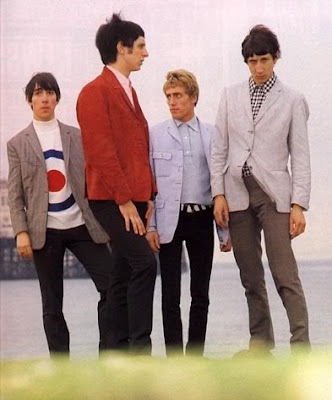
The Who, Pete Townshend, Keith Moon, Rodger Daltrey, John Entwistle, Mod
Shortly thereafter, the group came under the wing of manager Pete Meaden, who renamed them the High Numbers and gave them a better-dressed Mod image. The High Numbers released an unsuccessful single, "I'm the Face" b/w "Zoot Suit" (both written by Meaden), then got new managers, former small-time film directors Kit Lambert and Chris Stamp. By late 1964 the quartet became the Who again, and with Lambert and Stamp's encouragement they became an even more Mod band, with violent stage show and a repertoire including blues, James Brown, and Motown covers, solely because their Mod audiences loved that music. In fact, despite the billing, the Who's original songs were anything but classic R&B. The group's demo of "I Can't Explain," with sessionman Jimmy Page adding guitar, brought them to producer Shel Talmy (who had also worked with the Kinks) and got them a record deal. When "I Can't Explain" came out in January 1965, it was ignored until the band appeared on the TV show Ready, Steady, Go. Townshend smashed his guitar, Moon overturned his drums, and the song eventually reached Number Eight in Britain. "Anyway, Anyhow, Anywhere" also reached the British Top Tem, followed in November 1965 by "My Generation." It went to Number Two in the U.K. but only reached Number 75 in the U.S. But the Who were already stars in Britain, having established their sound and their personae. Townshend played guitar with full-circle windmilling motions, Daltrey strutted like a bantam fighter, Entwistle (whose occasional songwriting effort revealed a macabre sense of humor) just stood there seemingly unmoved as Moon happily flailed all over his drum kit.

After the Who's fourth hit single, "Substitute" (Number 5 U.K.), Lambert replaced Talmy as producer. Their second album, A Quick One (While He's Away) (Happy Jack in the U.S.; Number 67, 1967), included a 10-minute mini-opera as the title track, shortly before the Beatles' concept album Sgt. Pepper's Lonely Heart Club Band. The Who also began to make inroads in the U.S. with "Happy Jack" (Number 24, 1967) and a tour that included the performance filmed at the Monterey Pop Festival in June.

The Who, Pete Townshend, Keith Moon, Rodger Daltrey, John Entwistle, Mod, Who Photos
The Who Sell Out (Number 48, 1967) featured mock-advertisement songs and genuine jingles from offshore British pirate radio stations; it also contained another mini-opera, "Rael," and a Top Ten hit in England and the U.S., "I Can See for Miles." In October 1968 the band released Magic Bus (Number 39, 1968), a compilation of singles and B-sides, while Townshend worked on his 90 minute opus, Tommy. The story of a deaf, dumb, and blind boy turned pinball champion-pop idol turned autocratic messianic guru was variously considered both pretentious and profound. Most important, however, Tommy was the first successful rock opera. The album hit Number Four in the U.S., and its first single, "Pinball Wizard," went to Number 19. The band would perform Tommy in its entirety a handful of times – -at London's Coliseum in 1969, at New York City's Metropolitan Opera House on June 6th and 7th, 1970, and on some dates during its 1989 reunion tour. Excerpts, including "See Me, Feel Me," "Pinball Wizard," and the instrumental "Underture," were thereafter part of the live show. Troupes mounted productions of it around the world (the Who's performances had been concert versions), and Townshend oversaw a new recording of it in 1972, backed by the London Symphony and featuring Rod Stewart, Steve Winwood, Sandy Denny, and Richard Burton, among others. In 1975 Ken Russell directed the controversial high-pop film version, which included Eric Clapton ("Eyesight to the Blind"), Tina Turner ("Acid Queen"), and Elton John ("Pinball Wizard"), as well as Ann-Margret, Oliver Reed, and Jack Nicholson. Moon (as the lecherous Uncle Ernie) and Daltrey (in the lead title role) also appeared in the film.
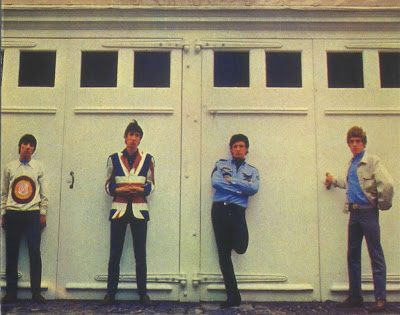
The Who, Pete Townshend, Keith Moon, Rodger Daltrey, John Entwistle, Mod, Who Photos
Bits of Tommy turned up on Live at Leeds (Number Four, 1970), a juggernaut live set, which was followed by Who's Next (Number Four, 1971), a staple of FM rock radio. It included Townshend's first experiments with synthesizers – "Baba O'Riley," "Bargain," "Won't Get Fooled Again" – three songs that Townshend originally conceived as part of another rock opera entitled Lifehouse. The singles comp Meaty, Beaty, Big, and Bouncy (Number 11, 1971) was followed two years later by the Who's second double-album rock opera, Quadrophenia (Number Two, 1973), a tribute to the tortured inner life of the Mods. It too was a hit and became a movie directed by Franc Roddam in 1979, with Sting of the Police in the wordless role of the bellboy.

While the Who were hugely popular, Quadrophenia signaled that Townshend was now a generation older than the fans he had initially spoken for. As he agonized over his role as an elder statesman of rock — as he would do for years to come — the Who released Odds and Sods (Number 15, 1974), a compilation of the previous decade's outtakes. The Who by Numbers (Number Eight, 1975) was the result of Townshend's self-appraisal ("However Much I Booze"); it lacked the Who's usual vigor, but yielded a hit single in "Squeeze Box" (Number 16, 1975). The band could dependably pack arenas wherever it went, but it took some time off the road after By Numbers.

The group members — whose personality clashes are almost as legendary as their music — began pursuing more individual projects. Moon released a novelty solo disc, Two Sides of the Moon, which featured guest stars galore; Entwistle recorded two solo LPs with bands called Ox and Rigor Mortis. Daltrey also recorded solo; his first two efforts are widely regarded as mediocre and he only had one Top 40 hit in the U.S., "Without Your Love," from the McVicar soundtrack. The Townshend-penned "After the Fire" received substantial video exposure when released in 1985. Daltrey found considerably more success as an actor. Besides Tommy, he starred in Ken Russell's over-the-top "biography" of composer Franz Liszt, Lisztomania (1975) and McVicar (1980), the true story of the famous British criminal John McVicar. In the mid-1980s he played the double role of the Dromio twins in a PBS production of Shakespeare's A Comedy of Errors. He's also appeared on the London stage (The Beggar's Opera, 1991) and on British television (The Little Match Girl, 1990). In 1999 he played Scrooge in a stage version of Charles Dickens's A Christmas Carol in New York City.

In 1970 Townshend contributed four tracks to Happy Birthday, a privately released, limited edition album recorded as a tribute to Townshend's guru, Meher Baba. The following year, I Am, a similar limited-edition Baba tribute album, was released. It contained another Townshend track, a nine-minute instrumental version of "Baba O'Riley." As both these records were heavily bootlegged, Townshend's response was to create an "offical" version of both albums. The result, Who Came First (Number 69, 1972), was Townshend's first "real" solo album. It included the tracks from Happy Birthday and I Am, plus new songs, and demos of the Who tracks "Pure and Easy" and "Let's See Action." His second solo release was a collaboration with ex-Faces Ronnie Lane, Rough Mix (Number 45, 1977), which featured a number of FM/AOR radio staples: "Street in the City," "My Baby Gives It Away," and "A Heart to Hang on To."

The Who, Pete Townshend, Keith Moon, Rodger Daltrey, John Entwistle, Mod, Who Photos
Meanwhile, punk was burgeoning in Britain, and the Sex Pistols among others were brandishing the Who's old power chords and attitude. Townshend's continuing identity crisis showed up in the title of Who Are You (Number Two, 1978), but the title song became a hit single (Number 14) that fall, and the album went double platinum. It was the last and highest-charting album of the original band.

The next few years brought tragedy and turmoil, and in a sense, the end of the Who in the death of Keith Moon. Moon always reveled in his reputation as the madman of rock, and his outrageous stunts, onstage and off, were legend. His prodigious drinking and drug abuse (he was once paralyzed for days after accidentally ingesting an elephant tranquilizer) had begun to diminish his playing ability. In 1975 he left England for L.A., where he continued to drink heavily. He returned to England and was trying to kick his alcoholism, but on September 7, 1978, Moon died of an overdose of a sedative, Heminevrin, that had been prescribed to prevent seizures induced by alcohol withdrawal. Although the group continued for another three years, each of the three surviving original members has stated repeatedly that the Who was never the same again.

In 1979 the Who oversaw a concert documentary of their early years, The Kids Are Alright (soundtrack, Number Eight, 1979), and worked on the soundtrack version of Quadrophenia (Number 46, 1979), which also included a number of Mod favorites performed by the original artists (such as Booker T. & the M.G.'s' "Green Onions" and James Brown's "Night Train"). Kenney Jones, formerly of the Small Faces, replaced Moon, and session keyboardist John "Rabbit" Bundrick began working with the Who. The new lineup toured, but tragedy struck again when 11 concert goers were killed — trampled to death or asphyxiated — in a rush for "festival seating" spots at Cincinnati's Riverfront Coliseum on December 3, 1979. The incident occurred before the show, and the group wasn't told of it until afterward.

After 15 years with Decca/MCA, the Who signed a band contract with Warner Bros., and Townshend got a solo deal with Atco. His Empty Glass (Number Five, 1980) included the U.S. Top 10 hit "Let My Love Open the Door" and "Rough Boys," a song long believed to have been an angry reply to a punk musician who had insulted the Who during an interview. Much later, in a 1989 interview with writer Timothy White, Townshend denied that was the case, saying, "It's about homosexuality," and adding that "And I Moved" was as well. Townshend's admission of having "had a gay life," and the statement "I know how it feels to be a woman because I am a woman," came as a surprise to many, including his band mates.

In 1981 Townshend performed solo with an acoustic guitar at a benefit for Amnesty International, which was recorded as The Secret Policeman's Ball. His falling asleep onstage was the first public sign of his deepening drug addiction. Since the year before, Townshend had been abusing alcohol, cocaine, and freebase cocaine mixed with heroin. He subsequently developed an addiction to Ativan, a tranquilizer he was prescribed during treatment for alcoholism. Ativan combined with freebase and heroin resulted in a highly publicized, near-fatal overdose during which he was rushed to the hospital from a London club. Townshend subsequently underwent electro-acupuncture treatment and cleaned up in 1982.

Amid all this, the revamped Who soldiered on. Face Dances (Number Four, 1981) included the hit single "You Better You Bet" (Number 18, 1981) and "Don't Let Go the Coat." But Townshend later called the new lineup's debut album a disappointment. One month after Face Dances came out, the Who's former producer/manager, Kit Lambert, died after falling down a flight of stairs; he was 45. (Pete Meadon had died three weeks before Moon, in 1978.) Townshend released the wordy All the Best Cowboys Have Chinese Eyes (Number 26, 1982), and soon followed it with the group's It's Hard (Number Eight, 1982), an album Daltrey has since been quoted as saying should never have been released. It produced the group's last Top 30 hit to date, "Athena" (Number 28). The Who then embarked on what they announced would be their last tour, ending with a concert in Toronto on December 17, 1982. Although the group officially broke up then, the Who have reunited to perform several times since. They appeared at Live Aid in 1985 and at a U.K. music-awards program in 1988. They celebrated the group's silver anniversary in 1989 with a 43-date tour of the U.S. which included guest-star-studded performances of Tommy in L.A. and New York, and later in London. For this tour Jones was replaced by session drummer Simon Phillips. It was also during this tour that Townshend, whose hearing was extremely damaged from years of listening to loud music through headphones, had to play standing behind a plastic baffle to block the onstage noise.

Townshend also released a number of solo projects throughout the 1980s: Scoop (Number 35, 1983) and Another Scoop (Number 198, 1987) collect demo tapes, home recordings, and sundry tracks of historical interest to fans. White City — a Novel (Number 26, 1985) is a concept piece, the soundtrack to a long-form video of the same title and includes "Face the Face"; The Iron Man: The Musical is the star-studded (Daltrey, Nina Simone, John Lee Hooker) soundtrack to Townshend's rock opera based on a children's story by poet Ted Hughes. Deep End Live!, released with an accompanying live video, barely scraped into the Top 100.

Townshend wrote in the liner notes to the 1994 box-set career retrospective Thirty Years of Maximum R&B: "I don't like the Who much . . . " Through the years of his derisive attitude toward the group has rung false at worst, disingenuous at best. In fact, Townshend's pride (and joy) in performing with the Who was abundantly clear during the band's 2000 tour, when he introduced it, happily, as "the fucking Who."

Despite Townshend's other projects and endeavors, including an editorship with book publisher Faber and Faber and publication of his collected stories, Horse's Neck (1985), the Who legacy endures. In 1993 the Broadway production of Tommy won five Tony Awards, including one for Townshend for Best Original Score. The next year saw the release of Townshend's PsychoDerelict (Number 118, 1994), a concept album that includes pieces written originally for the Lifehouse project. An examination of rock stardom's ravages, PsychoDerelict was also performed as a theater piece and filmed (it was subsequently broadcast on PBS). That year he also embarked on his first solo tour with a set list that included a number of Who classics, including "Won't Get Fooled Again." In February 1994 Townshend, Daltrey, and Entwistle reunited for Carnegie Hall performances in celebration of Daltrey's 50th birthday. Accompanied by a 65-piece orchestra, the trio was also joined by guest stars including Sinéad O'Connor, Eddie Vedder, and Lou Reed, and the show was filmed for cable television.

Two years later, the group recruited drummer Zak Starkey (son of Ringo Starr) along with a 12-piece backing band and embarked on a series o dates in which they performed the Quadrophenia album in its entirety for the first time. Townshend again stuck to rhythm guitar to preserve his hearing, leaving electric guitar duties to his brother Simon Townshend.

In 1999 Townshend reunited the band again for a charity concert at the House of Blues in Chicago, which led to yet another reunion tour the following year. This time around, however, the Who toured as a quintet: Townshend, Daltrey, Entwistle, Starkey, and John Bundrick on keyboards, with Townshend returning to electric guitar. The no-nonsense approach resulted in glowing reviews hailing the group's 2000 shows as some of their best in nearly two decades. A live album, Live: The Blues to the Bush/1999, was issued online via a partnership with Musicmaker.com, and the band even began talking about the possibility of a new studio set in the future. To cap their year, the Who received a Lifetime Achievement Award at the 43rd annual Grammy Awards.

In the midst of all the Who activity in late 1999 and 2000, Townshend returned yet again to his lifelong Lifehouse project. The BBC broadcast a Lifehouse radio play in December 1999, and in February 2000, Townshend performed the rock opera himself at London's Sadler's Wells Theater. Shortly thereafter he released a six-disc box set, Lifehouse Chronicles, on his own Eelpie label via his Web site; a single-disc version, Lifehouse Elements, was released in stores by Redline Entertainment. Daltrey has continued planning his pet project, a film biography of the life of Moon.

In October 2001, the Who appeared at the Concert for New York City, a 9/11 benefit, where the band was received with the most warmth of any act on the evening's program. But before they could continue on the road again the following summer, John Entwistle died of a cocaine-fueled heart attack in his hotel room. They went out anyway, with session bassist Pino Palladino filling in. In 2004, Townshend and Daltrey recorded a pair of new songs, "Old Red Wine" and "Real Good Looking Boy," for a compilation. (The Who have released more compilations since their initial breakup than they did studio albums before it.) In July 2005 they appeared in London as part of Live 8. In October 2006, the Who released Endless Wire, their first album under that name in 24 years. It reached Number Seven and received middling reviews. November 2007 saw the DVD release of Amazing Journey: The Story of the Who, an extensive band documentary.

Wikki Info can be found here http://en.wikipedia.org/wiki/The_Who

Have a groovy vintage retro day!

- Retro Rebirth

Retro T Shirt, Vintage Clothing, t-shirt, tee, vintage retro, psychedelic art, Warhol Pop Art

If you liked this article then make sure you subscribe to the feed via RSS It's Free. You can also follow me on Twitter too!

Become a Retro Rebirth Fan on our Facebook Page

Check out the Retro Rebirth Design Catalog and see what groovy vintage retro Music & Pop Culture designs we have for sale.

Wednesday, December 30, 2009

Rare 1967 Brian Jones Interview


This is the July 15, 1967 issue of Beat magazine that was dedicated entirely to the Monterey Pop Festival, which was held the month before. Brian attended the Festival to introduce Jimi Hendrix and while he was there one of the writers for The BEAT interviewed him. I would like to share this interview with all of you groovy cats.

BEAT: Can you comment about what’s happening this weekend in Monterey?
BRIAN: Very groovy scene. We’ve been very busy recording. I just came away for a few days and it’s so nice to get on someone else’s scene. It’s a very beautiful scene happening here.
BEAT: A lot of people have been sort of critical of this kind of happening in this country. The uptight people.
BRIAN: They’re frightened of trouble but I don’t expect any trouble, do you? It has been wonderful. I have been walking freely amongst everybody. Yesterday I was walking through and joining rings of kids and fans. You know I’ve never had a chance to do that much before. People are very nice here. I like it.
BEAT: Would you like to see this kind of thing happen all through the world?
BRIAN: We have had one in London and there are going to be more. But of course it should happen. I think it’s wonderful. The new generations expressing itself. This is one way of expressing itself.
BEAT: Do you like what’s happening with the new generation?
BRIAN: Yes, very much. There’s lots of hassles but things always have to get worse before they can get better. There are mistakes on both sides.
BEAT: What about the Stones – what’s happening with them?
BRIAN: We record practically all the time as the Beatles do. We just got about a week off so I came over here with Andrew (Andrew Oldham, Stones manager). The others have sort of split to various places, I think, I’m not quite sure. But nobody seemed to get it together to come over here. I wish they had ‘cause they have missed a very nice scene.
BEAT: What do you think about the Beatles new album?
BRIAN: It’s great. It’s too much. It’s really good. I did a Beatles’ session the other night, actually. On soprano saxophone, of all things. I’ve taken up playing reeds again. I used to play reed instruments. I bought a soprano saxophone the other day and ever since I have been doing sessions on it. There are soprano saxophones on the Stones’ records, future Beatle records. You know, it’s a funny thing – you get hold of something and put it on everyone’s records. It’s great. There’s a very nice recording scene going on right now in London.
BEAT: There have been rumors that the Stones and Beatles are going to record together. Could you comment on that?
BRIAN: It would be at a certain stage. It would be a very nice thing. We are getting very close as far as work is concerned. Whether actually we could – well we could work something out together. From one point of view it might not be a very good thing because our direction is slightly different from theirs. Lack of distinction because of the joining up of the two might be lost. That’s the only thing that could spoil it, I think. There will certainly be schemes. We spend an awful lot of time with each other now. We’ve got a lot of mutual ideas.
BEAT: It certainly would be wild from the standpoint of a combination of sounds. It would seem to me that you would come up with something really unique.
BRIAN: It’s happening already. As I said, I did this Beatle session – mixed on a Beatle session, various things. Paul’s done a couple of ours. You know, it’s already happening.
BEAT: It’s taking that direction, anyway.
BRIAN: Yeah, and that’s not a bad direction.
BEAT: We’re glad to have you in Monterey.
BRIAN: It’s nice to let people know we’re still functioning. Still around – still on the scene – still doing all we can.
BEAT: How long are you going to be over here, Brian?
BRIAN: I’m just going to be here for a very few days. Just a little break from recording and everything.
BEAT: Are there any immediate plans for coming back over after the court stuff is cleared up?
BRIAN: No, not at the moment but everything’s going to be all right. The big job at hand is to get the L.P. done and we’re spending an awful lot of time on it this time. It’s going to be more of a production. We’ve really put some thought into it because people are still liking our albums so we’re trying to really give them something that will take them on a stage further. And, so that they will take us on a stage further. We feel at the moment that our important work is to be done in the studio rather than in baseball halls and stadiums around the country. You see, once you’ve been around the country once or twice people have seen you and it’s a question of what’s to be gained by going around again. But, there’s a lot to be gained by letting them share our progressions because we are progressing musically very fast.
BEAT: You’re in a position to please yourselves more now, aren’t you?
BRIAN: Well to a certain extent that’s always been true. But we can’t really please ourselves. We have too large a public who depend on us to be able to please ourselves.
BEAT: That’s the best costume I’ve seen at the Festival. It’s beautiful – a work of art.
BRIAN: Well, it’s Old English and European stuff.
BEAT: Did you fly here?
BRIAN: Yes, I flew in the other night. I came by New York and Los Angeles. I spent about one hour in New York and five minutes in Los Angeles. Then I was flown straight out here on a jet. The Mamas and Papas, I think, own it or rent it or something.
BEAT: Any schedule after the Festival?
BRIAN: I’ve got a few things to take care of at home so I might be leaving as soon as the festival is over. On the other hand, I might just take in Los Angeles and New York on the way back and look up a few old friends. It’s nice to come over here. I’m glad I came.
BEAT: There’s a Love-in scheduled for Los Angeles soon. Have you heard about this?
BRIAN: It’s such a different scene over here from back home. You have more of a problem or at least it’s more acute over here then we do.
BEAT: Which problem is that?
BRIAN: The whole problem of social change which is going on around the Western world right now. It’s going on in the Eastern world too, but in a different way. We won’t talk about that.
BEAT: Do you think the Pop Festival would look like this or have an atmosphere like this if it had been held on London rather than in California?
BRIAN: Yeah. We’ve had a similar affair in London and there are going to be more. I would like to see these affairs become a regular part of young community life because I think these people here – from what I’ve seen so far – are acting as a community. They have the community spirit, the community feeling. I haven’t seen any signs of any trouble or enmity. It’s very nice. People are showing each other around and it’s very beautiful. I’m glad I came. I’ll have lots of nice things to say when I get back home.

Have a groovy day :)

Peace and Love,
Retro Rebirth

If you liked this article, make sure you subscribe to the feed via RSS

Check out the Retro Rebirth Design Catalog

Tuesday, December 29, 2009

Brian Jones Tribute


Brian Jones Biography
(February 28, 1942 – July 3, 1969)


Musician. Born Lewis Brian Hopkin Jones on February 28, 1942 in Cheltenham, Gloucestershire, England. Born during World War II to Welsh parents, Brian Jones suffered from asthma as a child and throughout his life. His father and mother both played music, and by the time he was in high school, Brian had learned to play the piano, clarinet, saxophone and guitar. Though Jones was incredibly bright, he was a lazy student. He quit school and left home shortly after a scandal in which he fathered an illegitimate baby boy who was subsequently given up for adoption.


Jones moved to London to play blues guitar in local bars. In the spring of 1962, he formed The Rolling Stones with pianist Ian Stewart, singer Mick Jagger, and Jagger's childhood friend and guitarist Keith Richards. Bassist Bill Wyman and jazz-influenced drummer Charlie Watts soon joined the band.


During The Rolling Stones’ early days, Jones served as leader, entertainer and manager for the band. As the most photogenic band member, his antics and fashion sense were quickly adopted by the swingers of 1960s London. In 1963, the band hired manager Andrew Loog Oldham, who helped them cultivate a rough, somewhat menacing persona. Oldham’s arrival also marked the decline of Jones as ringleader. Jagger and Richard, who did much of the songwriting, soon moved into the spotlight.


Though he was chiefly known as a guitarist, especially for the guitar weaving he did with Richards, Jones played numerous instruments during his years with the Stones: sitar, tamboura, dulcimer, keyboards, recorder, harmonica, xylophone and marimba, among others. By the mid 1960s, Jones was feeling increasingly alienated by the band and became more and more dependent on drugs and alcohol. He was first arrested for drug use in May of 1967, and by May of 1968, he was recording his final substantial contributions with the Stones.


On June 8, 1969, following the recording of Let it Bleed, Jones was asked to leave the band. A month later, he was found at the bottom of his swimming pool at his home in Sussex, England. The death was ruled an accident. He was 27 years old.


Wiki Info Here - http://en.wikipedia.org/wiki/Brian_Jones


Have a groovy day :)

Peace and Love,
Retro Rebirth

If you liked this article, make sure you subscribe to the feed via RSS

Check out the Retro Rebirth Design Catalog

Friday, November 27, 2009

Be Thankful!!


Retro Rebirth is BACK!!!

prepare for the weirdness...
Related Posts with Thumbnails